North Kivu has four seasons: Two wet seasons and two very short dry seasons
Originally published on Global Voices
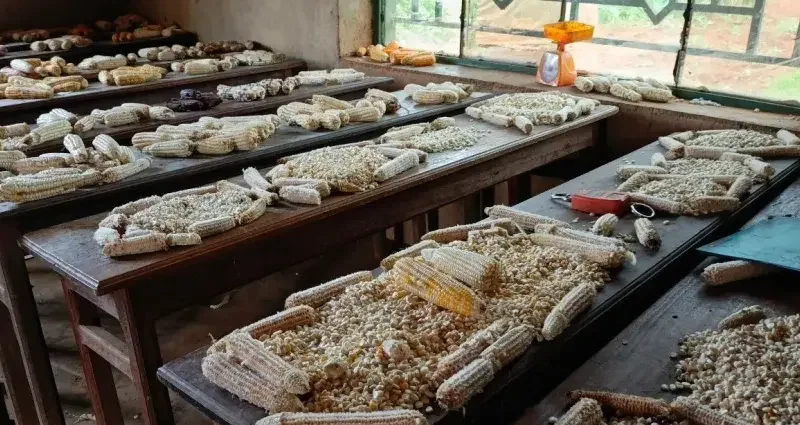
A maize variety exhibition. Photo by Hervé Mukulu from GreenAfia, used with permission
This article by Hervé Mukulu was first published on the news site Icicongo on November 16, 2025, with support from the Pulitzer Center. Global Voices republished the article as part of a partnership agreement with Icicongo.
Climate change has impacted North Kivu, a region in the eastern Democratic Republic of the Congo (DRC), where farmers have had to adapt their farming practices to survive.
Shortened seasons, prolonged droughts, and torrential rain are the daily challenges facing farmers amid this increasingly unpredictable climate, where heavy downpours heighten the risk of flooding and erosion. Data from the 2012 Geo-Eco-Trop research journal shows that the region’s annual rainfall remains close to 1,500 mm, while the average daily rainfall intensity has increased slightly (+0.1 mm/day). As such, days with over 10 mm of rain have increased by around three per year, and climate change has shortened the rainy season from 9 months to 7, further threatening food security.
According to the same study, the increased flooding is primarily due to rapid and uncontrolled urbanization. Urban planning and appropriate infrastructure are therefore essential. In light of this, scientists propose using adapted farming techniques, resilient seeds, and a move towards agroforestry.
Farming at the mercy of the rain
According to the Development Indicators Analysis Unit (CAID), North Kivu has four seasons: two wet seasons (from mid-August to mid-January and from mid-February to mid-July) and two very short dry seasons (between mid-January and mid-February and between mid-July and mid-August).
Mulondi Gloire, an agricultural engineer and expert in land-use planning, states that two farming seasons punctuate the year: a short season extending from March to May and a long season extending from August to November. He explains how the success of a harvest directly depends on rainfall frequency:
Notre agriculture reste familiale, de petite échelle, et dépend entièrement des saisons de pluie.
Our farming remains family-run, small-scale, and depends entirely on the rainy seasons.
After all, the irrigation that would make it possible to overcome this dependence remains rare. Due to a lack of financial and technical means and rugged terrain, many farmers still farm “at the mercy of the rain.”
Charles Valimunzigha, Professor of Agricultural Sciences and Director of the Agronomic and Veterinary Research Center of Graben (CERAVEG), states that the paradox is glaring:
L’eau n’est pas absente : rivières, ruisseaux et nappes souterraines abondent. Le problème, c’est notre incapacité à la capter et à la gérer.
Water isn’t lacking. Rivers, streams, and groundwater are abundant. The problem is our inability to collect and manage it.
Climate data collected by the Enzymes Raffiners Association (ENRA Beni), the Agricultural and Veterinary Technical Institute of Butembo (ITAV Butembo), and the National Institute for Agronomic Research (INERA Yangambi) confirm a change in rainfall frequency.
La quantité annuelle évolue peu, mais leur intensité augmente. Des épisodes extrêmes (grêle, orages violents) frappent plus souvent, parfois en pleine période censée être sèche et détruisent les semis cultures.
Although the annual quantity hasn’t changed much, its intensity has increased. Extreme weather events (hail, severe thunderstorms) happen more frequently, often during periods that are supposed to be dry, destroying seedlings and crops.
On top of this rainfall variability, another obstacle is the seeds that are often old, unproductive, and cultivated using methods that seem frozen in time. However, farmers, NGOs, research centers, and the authorities have responded, stepping up their efforts to develop climate-resilient crop varieties.
Read more: The key to saving potato cultivation amid climate disruption in the Democratic Republic of the Congo
This unstable weather also facilitates the outbreak of diseases, such as mildew (a cryptogamic disease affecting many plant species) and fungal infestations, thereby weakening crop yields. Gloire Mulondi explains:
Nous assistons à des manifestations locales du changement climatique global liées à l’augmentation des gaz à effet de serre.
We are witnessing local manifestations of global climate change driven by increased greenhouse gas emissions.
Developing sustainable farming
Plant researcher, Héritier Mbusa, says the way forward is clear:
…planifier, irriguer et diversifier. Passer d’une agriculture de survie à un système capable d’anticiper et de s’adapter, grâce à la technologie, à la reforestation et à des variétés mieux armées face aux aléas climatiques.
Planning, irrigating, and diversifying. Transitioning from subsistence farming to a system capable of anticipating and adapting, using technology, reforestation, and varieties better equipped to withstand weather hazards.
For Sahani Walere, an expert in natural disaster management, local farming has reached an impasse:
Nous ne pouvons garantir une agriculture durable si nous n’envisageons pas des mécanismes d’adaptation au changement climatique.
We cannot ensure sustainable farming unless we consider mechanisms for adapting to climate change.
He calls for a regional weather station network to establish a reliable farming calendar.
The researcher explains that the data show an average temperature increase of 1.8 degrees Celsius over 50 years and increased disruptions during short rainy seasons.
Si les émissions de gaz à effet de serre se poursuivent, même la petite agriculture, colonne vertébrale de l’économie locale, pourrait disparaître.
If greenhouse gas emissions continue, even smallholder farming, the backbone of the local economy, could disappear.
He therefore calls on policymakers to incorporate climate data into farming strategies to safeguard production.
To deal with these challenges, the chief coordinator, Gloire Mulondi, calls for an agroforestry- and agroecology-based transition towards resilient farming. He states:
Nous devons adopter des nouvelles pratiques adaptées aux nouvelles réalités climatiques.
We must adopt new practices adapted to the new climate realities.
Gloire Mulondi also insists on preserving soil fertility and reducing emissions from deforestation and slash-and-burn land clearing. For him, technology, satellite imagery, soil mapping, and digital tools must be leveraged, especially since “agroecology hinges upon the balance between plants, soil, and the environment, limits chemical inputs, and supports biodiversity.”