From classrooms to courtrooms to cyberspace, grassroots feminists are redefining gender justice
Originally published on Global Voices
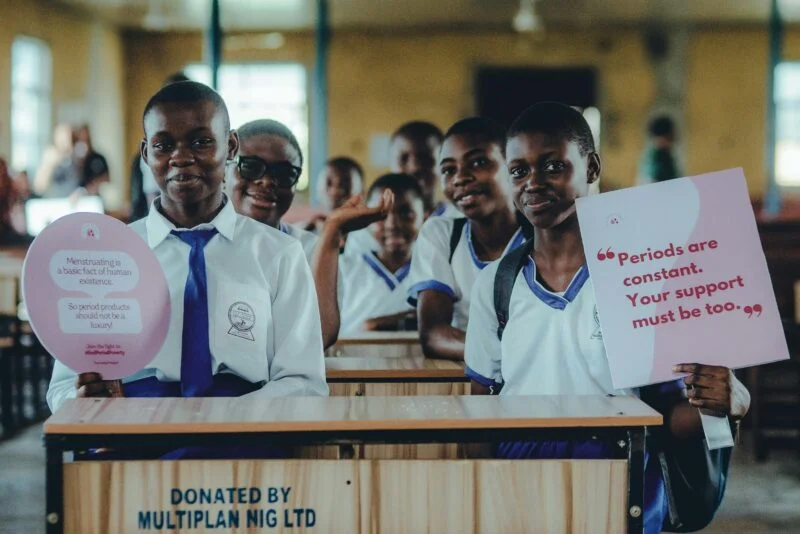
Girls holding signs calling for period justice at a school in Nigeria. Image from Pexels. Free to use.
By Clarisse Sih and Bibbi Abruzzini, Forus
In a secondary school in southern Nigeria, a teenage girl got her period during class hours. She had no sanitary pads. The teacher sent her home.
For Udoka Anita Ikebua, then a young graduate posted to the school for national service, that moment became a turning point. “In the 21st century,” she remembers thinking, “how can a girl still not have access to something so basic?”
This is how Ikebua’s initiative evolved into one of Nigeria’s most significant menstrual justice victories: in March 2025, Bauchi State passed the country’s first bill establishing free sanitary pad banks in public schools and correctional centers — a shift from charity to rights-based policy.
Across continents, similar transformations are unfolding. In Pakistan, feminist advocates are reframing social protection as democratic infrastructure. In Paraguay, digital rights activists are challenging the normalization of gender-based violence.
Their struggles may look different — period poverty, policy reform, digital abuse — but they are united by a deeper truth: gender justice today is inseparable from economic security, digital safety, and institutional accountability.
Nigeria: From pad donations to policy reform
Ikebua founded Project Pad A Girl after witnessing firsthand how menstruation interrupted girls’ education. Initially, the solution seemed simple: distribute sanitary pads. But she quickly realized the limits of charity. “If I give one pad today,” she explains, “what happens next month?”
Girls without access to sanitary products during their periods often resort to using tissue paper, rags, leaves, or simply staying home. Teachers would sometimes send students away if they stained their uniforms.
The breakthrough came with the creation of pad banks: permanent, school-based emergency supply boxes stocked with menstrual products each term. Girls who begin menstruating during school hours can discreetly access supplies from the counselor’s office and remain in class.
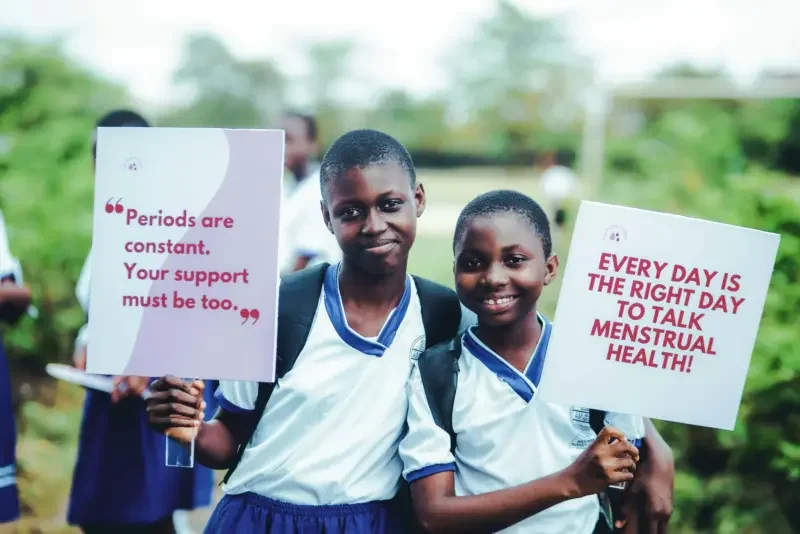
Nigerian schoolgirls holding signs calling for period justice. Image from Pexels. Free to use.
The impact has been immediate: improved attendance, reduced stigma, and a sense of security.
“The idea that if my period comes, I am safe — that changes everything,” Ikebua says.
Crucially, Project Pad A Girl intentionally includes boys in menstrual education sessions to dismantle shame. “As you are not ashamed of your body,” Ikebua tells male students, “you should not make a girl ashamed of hers.”
The Bauchi legislation expanded this model further, to include correctional facilities, where incarcerated women often rely on rags and face severe hygiene risks. By introducing reusable sanitary pads designed to last months, the initiative centers dignity and sustainability.
“It’s about being seen — even behind prison walls,” Ikebua explains.
Yet challenges remain. Menstrual products are subject to a value-added tax, the removal of which advocates are lobbying for, but progress is slow in a male-dominated legislature where, Ikebua admits, “sometimes when you take it to men, they don’t really understand.”
Pakistan: Social protection as feminist infrastructure
For Marium Amjad Khan, programme manager at the Pakistan Development Alliance, feminism is not an abstract theory. It began with witnessing girls’ futures decided before they had a chance to dream.
“Once you see inequality,” she says, “you cannot unsee it.”
Working at both grassroots and policy levels, Khan focuses on child marriage, domestic violence, sexual and reproductive health rights, and education governance. But increasingly, she emphasizes social protection — economic systems that determine whether women can withstand crises.
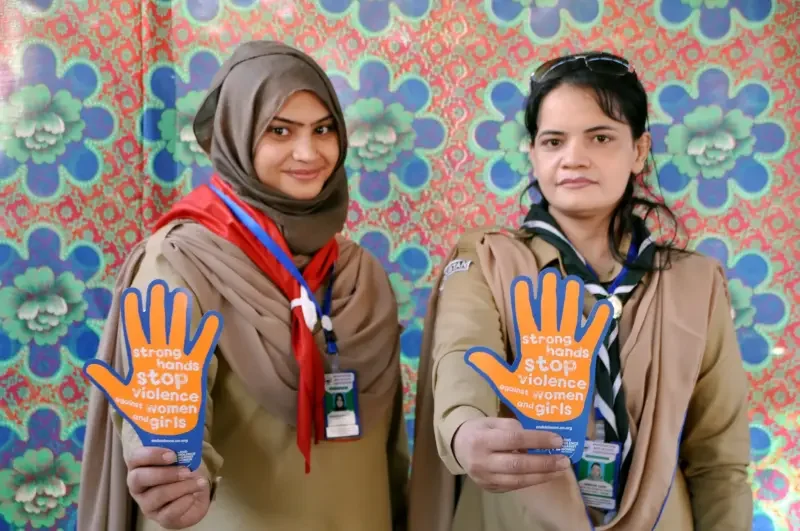
Girl Scouts in Balochistan, Pakistan, hold signs that say ‘Strong hands stop violence against women and girls.’ Image from UN Women Flickr (CC BY-NC-ND 2.0).
Without economic security, democratic participation is fragile. Women burdened by poverty, unpaid care work, or climate shocks are less able to organize, advocate, or run for office. “Laws are only beginning,” Amjad explains. “Real change happens when communities begin to believe that girls deserve childhood, that women deserve safety.”
Pakistan has passed important legislation in recent years, but implementation remains uneven. A central challenge, she notes, is awareness: many communities do not know their rights. Coalitions, therefore, are essential. The Pakistan Development Alliance brings together over 115 civil society organizations, amplifying collective voices in policy spaces. “When communities speak together, policymakers listen,” Khan posits. “They have to.”
In a context of a shrinking enabling environment for civil society, global feminist solidarity provides reinforcement.
“When space shrinks in one country, international networks remind us we are not alone.”
For Khan, feminist leadership is not about being the loudest voice; it is about creating space for other voices.
Paraguay: Digital violence is real
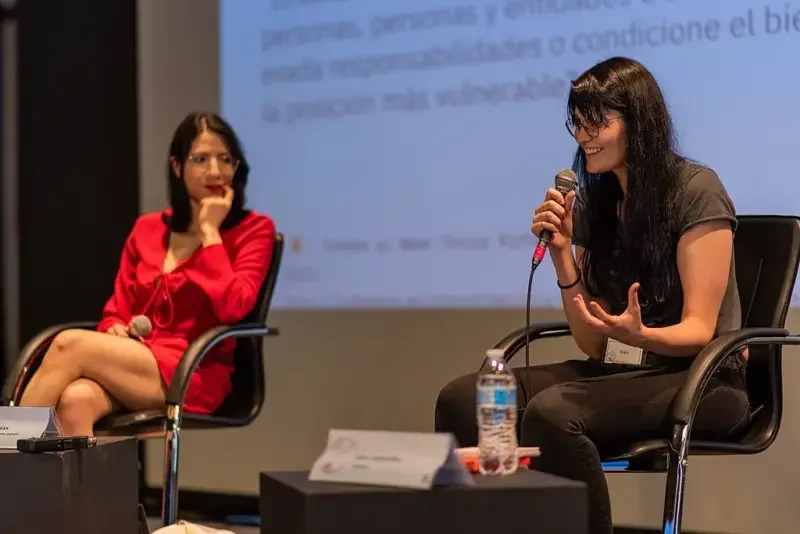
Transformative Justice and Digital Violence Workshop by Alex Argüelles and Grecia Macías. Image via Wikimedia Commons. License CC BY-SA 4.0.

While menstrual dignity and social protection operate in physical spaces, in Paraguay, the struggle unfolds online.
TEDIC, a digital rights organization, leads the campaign, La Violencia Digital es Real (Digital Violence is Real), to challenge the idea that online abuse is somehow less serious than offline harm.
“A message on the internet can cost someone their job, their safety, their peace,” explains project lead Jazmín Ruiz Díaz.
For years, the internet was treated as neutral, a space that would naturally advance equality. Instead, inequalities have been amplified.
TEDIC’s emblematic case is that of Belén Whittingslow, a student who accused a powerful university professor of harassment via explicit messages. The case was dismissed as “courtship.” She was later criminalized and forced to seek refuge abroad. The professor faced no legal consequences.
The case illustrates the layered nature of digital violence, how power, institutions, and platforms intersect. Beyond individual attacks, activists faced coordinated online harassment that attempted to silence their advocacy and discredit their work. The responses from institutions and the limitations of platform moderation further complicated the situation, revealing how gaps in accountability and regulation can allow online abuse to persist. In this way, the experience highlights how digital violence is not only a personal attack but also a structural issue shaped by social power dynamics, institutional responses, and the governance of digital platforms.
Ruiz Díaz also notes that perpetrators are not only anonymous trolls. These actors can range from coordinated harassment networks and state-backed troll farms to the platforms themselves, where opaque moderation systems and algorithmic bias have been widely criticized. Investigations and media reports have documented cases where online attacks against women journalists, politicians, and activists are amplified by organized networks, while platform responses remain inconsistent.
Through its Free and Safe on the Internet initiative, TEDIC provides digital security training to activists, LGBTQ+ communities, and civil society groups. The work is slow, incremental — “a work of ants,” Ruiz Díaz says — but necessary.
As new technologies emerge, so do new forms of harm. Deepfakes, non-consensual image manipulation, surveillance technologies, and AI tools have intensified risks.
“Cyberspace is not separate from reality,” Ruiz Díaz emphasizes. “Violence online has real effects on bodies and minds.”
Addressing it requires coordinated action from governments, tech companies, and civil society. But it also requires community care.
“The exit is collective,” she says, “and joy is also a form of resistance.”
Redefining gender justice
What connects a pad box in a Nigerian school, a coalition meeting in Pakistan, and a digital security workshop in Paraguay? They each address a structural barrier that limits women’s participation in education, in governance, in digital public life.
Menstrual dignity affects school retention and long-term economic opportunity. Social protection shapes political agency. Digital safety determines who can speak freely.
These are not peripheral concerns. They are pillars of democracy.
From classrooms to courtrooms to cyberspace, grassroots feminists are redefining gender justice — not as symbolic recognition, but as systemic transformation.
And in doing so, they are reshaping the institutions that govern everyday life.