Betis arrive with momentum and a clear target
Real Betis arrive in Dortmund with a perfect Champions League record and a chance to test whether Borussia Dortmund can turn their uneven European campaign around. Betis have won all three matches against Lille, Porto and Feyenoord, placing them among seven unbeaten teams in the competition. That run gives the Spanish side a useful platform, though it doesn't guarantee they can carry the same control into a difficult away fixture.
Their domestic position adds weight to the story. Betis sit fourth in LaLiga with 23 points, four behind third-place Real Madrid, so their European progress is coming alongside a strong league campaign. For a club back in this tournament after 21 years, keeping both competitions on track is a meaningful test of the squad's depth and consistency.
Betis qualified for the Champions League after LaLiga secured one of two European Performance Spots. Their return has gone better than many might've expected, and Manuel Pellegrini's team now have their sights on a top-eight finish. A win in Dortmund would strengthen their case, but it would also show that their unbeaten start can withstand pressure away from home.
A demanding test for Dortmund
Dortmund sit 16th in the Champions League table, leaving them with ground to make up. The home fixture gives Niko Kovač's side a chance to improve their position after a start that hasn't yet matched their ambitions. That makes this more than a routine league-phase match: the result could shape how much room Dortmund have to recover in the remaining campaign.
Betis bring a different kind of problem from the one Dortmund faced against Bayern. The visitors have shown they can win against varied opposition, while their league standing suggests they aren't relying on European results alone to make the season feel successful. Dortmund will need to manage the match as a contest over territory and patience, not simply assume their home setting will turn pressure into goals.
Here's the thing: Betis can play with the confidence of a team whose results have already rewarded its approach. Dortmund, by contrast, have a more immediate need to find a result. That difference in pressure may matter as the game develops, especially if neither side scores early.
Bartra's return adds a personal thread
The fixture also brings Marc Bartra back to Dortmund. He spent a season and a half at the German club before joining Betis, and the 35-year-old is expected to feature in the visitors' defense. He has scored four goals this season, an unusual contribution for a defender that gives Betis another source of threat on set pieces and attacking transitions.

Bartra's familiarity with Dortmund gives the match a human detail, but his current role is more important than the nostalgia. Betis will need their defense to stay organized against a side looking for a foothold, and his experience could help them handle the home crowd and the shifts in momentum. Four goals also mean Dortmund can't treat him as a purely defensive presence.
Isco carries the creative burden
With Cucho Hernández sidelined by injury, Betis will look to captain Isco to shape their attack. The 34-year-old operates behind Troy Parrott, drifting into space and directing play. In that role, he can connect the midfield to the forward line and give Betis a way to keep possession moving when Dortmund close down the obvious passing lanes.
His midfield contest with Felix Nmecha, Veerman or Jobe could help decide whether Betis control the game. Isco has two goals and one assist in this Champions League campaign, output that underlines his influence without making him the visitors' only attacking option. If you're watching for the tactical hinge, watch the space around him: Dortmund's ability to limit his time on the ball could shape how often Parrott gets involved.

And yet, Betis' dependence on Isco has a clear limit. With Hernández unavailable, the captain may have to take on more responsibility for creating chances and setting the tempo. That's a burden Dortmund can target, though containing one player is easier to describe than to execute when he has room to drift across the pitch.
Dortmund’s likely shape and scoreline
Dortmund used a back four for extended spells against Bayern, with Gadou deployed as a defensive right-back. Kovač is expected to return to a three-man defense, with Schlotterbeck, Anton and Gadou. Ryerson and Svensson could occupy the wide roles, while Jobe and Veerman anchor midfield. Karetsas is tipped to create behind Silva and Guirassy.
A three-man defense would give Dortmund a different platform from the setup they used for much of the Bayern match. The wing roles could become particularly important: Ryerson and Svensson would need to support attacks while helping the back line cope with Betis' movement. The predicted arrangement also places Karetsas behind two forwards, a structure that could give Dortmund more than one route into the penalty area.
Predicted Lineup: 3-4-1-2
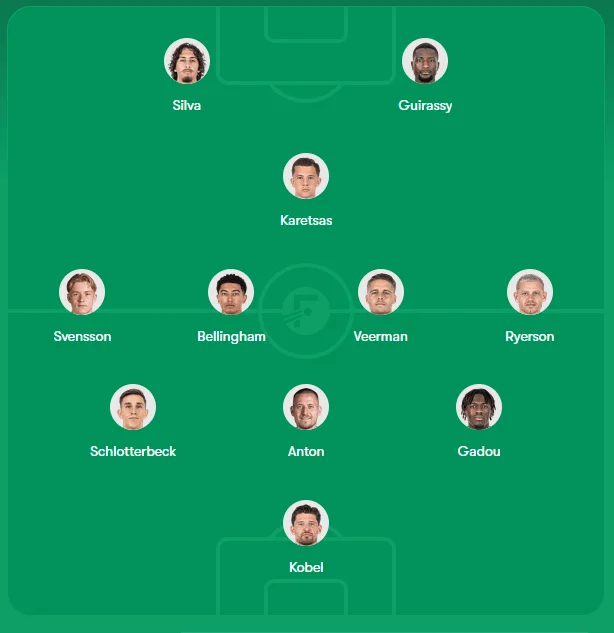
A 2-2 draw looks plausible after Dortmund's demanding match against Bayern. They could build a two-goal lead before Betis rally late, leaving both sides with a point and Dortmund still searching for a stronger foothold in Europe. The prediction captures the central tension: Dortmund may have the energy to start forcefully, while Betis' unbeaten run gives them reason to believe they can recover if the match turns against them.
What the result could say about both campaigns
For Betis, the significance lies in whether they can turn a perfect opening into a sustained challenge for a top-eight finish. Their three wins have made that ambition credible, but an away match against Dortmund offers a different kind of examination: can they keep their composure when the opponent has both home advantage and a pressing need for points? A draw would preserve their unbeaten record, while a win would make their early form harder to dismiss as a brief run of good results.
Dortmund need a performance that gives their campaign direction. A point would leave them still searching for a stronger foothold, as the prediction suggests, while a victory could ease some of the pressure created by their position in the table. This is more significant than it looks for a match between sides with such different starts: it tests whether Dortmund can convert urgency into control, and whether Betis can keep winning when the stakes and setting change.
(and this is the part most people overlook) The match may be decided by how each side responds after conceding, rather than by which team begins with more possession. Betis have shown they can score, and Dortmund are expected to threaten with two forwards. Small stretches of defensive concentration could count for as much as the headline attacking names.
One point apiece. That would leave Betis unbeaten and Dortmund with work still to do.